DAILY PACING PLAN
(50 Minute Period)
8:00 - 8:05
Students complete warm-ups.
8:05 - 8:10
Correct warm-ups.
8:10 - 8:20
Correct and review homework.
8:20 - 8:40
New lesson (See following lesson plan for detail. Please note that in this case, Warm-Ups and review are omitted since the following lesson is the first day of Algebra instruction.)
8:40 - 8:47
Independent practice with new topic.
8:47 - 8:50
Remind students what they have learned today, clarify homework (if necessary), and provide students time to gather materials.
Formal Formative Assessments administered every Friday.
"Algebra Menu" Lesson:
Class Seventh Grade Pre-Algebra or Algebra 1 Period Not Applicable .
Unit Variables and Equations/ Getting started with Algebra Date Not Applicable ..
CA Content Standards Addressed Number Sense- 1.0 Students know the properties of, and compute with, rational numbers expressed in a variety of forms: 1.2 Add, subtract, multiply, and divide rational numbers (integers, fractions, and terminating decimals) and take positive rational numbers to whole-number powers. Algebra and Functions- 1.0 Students express quantitative relationships by using algebraic terminology, expressions, equations, inequalities, and graphs: 1.4 Use algebraic terminology (e.g., variable, equation, term, coefficient, inequality, expression, constant) correctly.
ELD Standards Addressed Reading- Word Analysis- Decoding and Word Recognition- Apply knowledge of common English morphemes in oral and silent reading to derive meaning from literature and texts in content areas.
Student Neurodevelopmental (N-D) strengths/ weaknesses/ affinities and differentiated instruction: This lesson is basic and simple in concept, and also the “real-life” application is so common in everyday life that difficulties for students whom are less advanced are not expected to arise. In my experience, I have had great success with this lesson with past Pre-Algebra and Algeba classes. While the concepts are simple, however, the arithmetic used in the “menu” will begin initially with simple whole numbers and, later in the period, advance to decimals to the "hundredths place" just as the traditional prices in many restaurants do. These problems will challenge and hold the interest of more advanced students.
D
IFFERENTIATED INSTRUCTION: Since the main objective of this lesson is to achieve success with using letters to represent numbers for the first time, I will especially focus on one important aspect of the many techniques of differentiated instruction which I employ on a daily basis. This aspect of adjusting instruction for different levels of student understanding and different ways of student learning is that of utilizing the simplest language possible. Instead of using mathematical vocabulary that might confuse or even intimidate some students that do not excel at math, I will use words that are “friendly”. For example, in this lesson I will avoid words such as “sum” and “product” when working problems with students in order to focus in on the objective of the day, which is to introduce using letters to represent numbers for the first time. It is extremely important that during this crucial Algebra lesson students that are weak in mathematics experience success and are not become "lost" or "scared away" by any academic language. In addition, this will also help to keep the restaurant theme of the lesson more “real”, and applicable to everyday life (most likely restaurant employees would not use words like “product”, “sum”, or “calculate” at work). Please note that later in the year, of course, mathematical vocabulary will be addressed in great detail, as it is necessary to solve many problems in the subject.Objectives: Students will be able to solve simple algebraic equations with known variables without difficulty and use the terms Variable and Equation comfortably with a basic understanding of their meaning.
Materials Needed I would prefer the standard equipment in use in my classroom, which includes an LCD projector connected to my laptop (with the prepared "Algebra Menu" image file loaded onto a Microsoft One Note page) which I can manipulate wirelessly from a writing tablet or an iPad. However, if this is unavailable or fails, an overhead projector, overhead projector markers, overhead projector transparencies, overhead projector transparency prepared for this lesson (optional), Whiteboard, and Whiteboard Markers could also be utilized for the same outcome. Also, small Post-It Notes for all students. ..
Agenda
1. Warm-Up/ Anticipatory Set 1
(Quick-write)- 5 minutes
As students enter the classroom, the designated place on the board for Daily Warm-Ups will read, “Quick-Write: What is your favorite Food? Why? What is your least favorite food? Why? What is your favorite restaurant? Why? What is your favorite cuisine, or type of food (Chinese, Japanese, Barbeque, American, Italian, etc.)? Why? What is your favorite food to eat at home? Can you cook it? What is your favorite breakfast food? What is your favorite lunch? What is your favorite dessert? What are your five favorite candies?”
2. Anticipatory Set 2 (Verbal
Introduction)- 2 minutes
“All of you noticed that our warm-up today is not about math. What is it about?” Everyone says, “Food!” “That’s right. Today we will be talking about food! Actually, we are going to start our own restaurant! But first, we have to decide what kind of food to cook. Don’t worry, though. I’m sure that we’ll find some math along the way...”
3. Create Menu- 10-15 minutes
“We are going to vote for the class’s favorite food or cuisine.” One student will volunteer to be the “recorder” on the board, and after recording all of the different cuisines and/or foods, we will take a “post-it vote” Every student will have a small post-it note on his or her desk at the beginning of class, and when prompted he or she will walk up to the board and place their post-it note next to their favorite food.
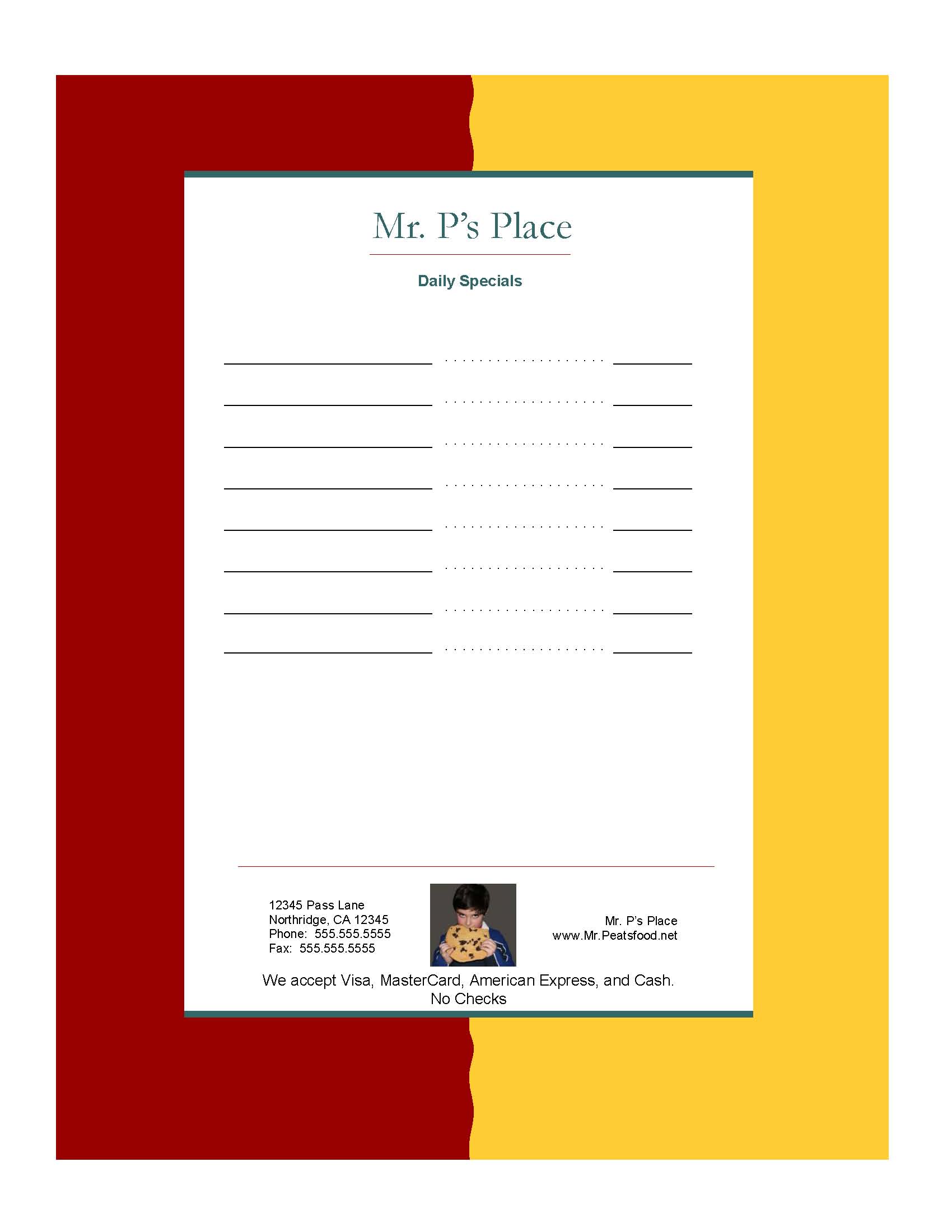
At this point, I will bring up the blank menu on the overhead projector that reads “Mr P’s Place”, and we will begin creating our menu. I will let students call out foods and prices, but be careful to choose only two menu items which share the same first letter. This is very important, as it will allow students to quickly grasp the concept with the first several problems, as well as to create a need to “define variables”, which we will see soon in the lesson.
4. Interactive Direct Instruction
with some Independent
Practice- 25 minutes
"Let's say that we found a great place for our restaurant. The front is painted, the inside is decorated, and everything is ready to go! People have been waiting for the restaurant to open, and 7,000 people were lined up outside and waited all night until you opened your doors. Unfortunately, there is one little problem. Our waiter was in such a rush that he didn’t have time to write the orders out!!! You were the cashier, and your job was to total up the customer’s check. Let's see if you could figure out the first order. The waiter handed you a piece of paper that said:” “h+f”. “Raise your hand when you’ve figured this out…” When many of the students have an answer, I will ask the entire class, “What is the answer?” Then, I will begin questioning a student that was confident with the answer. “What do you mean? How did you know that? Oh! The ‘h’ must stand for ‘hamburger’ and the ‘f’ must stand for ‘fries’. That’s easy! And now we have a full equation! Everyone write that word down. ‘Equation’. That means that we have something on both sides of the equal sign. Let’s move on to the second order.” It will be similar to the first. ***“Learning Math is so important! We couldn’t run our restaurant without it!”***
At this point, I will write out ten problems for students to practice. The will be just as simple, with two items being added together.
"Believe it or not, you are all doing Algebra already!!! You may have heard that Algebra is hard, but this is basically all that Algebra is! Using a letter to represent a number!
"These problems are pretty easy. Besides, people won’t only order two things, right? What if..." We will now continue the lesson with longer addition problems, and on the second problem I will use the letter which is repeated and could represent two items. If a student gives one answer, I will give the other and argue that mine is correct! In my experience, the class will not allow me to move on to the next problem! “Hey wait a second!!! What is ‘s’?????” “Aha!!!!! That’s what we have to do- I’ll tell you what it’s called in a second. For now let’s say that ‘s’ stands for a small soda….” After we finish the arithmetic I will say, “We couldn’t finish the problem without deciding what ‘s’ was. The cashier would have to ask the waiter what he meant! Joey, what are these called? Anna, what are these called? Everyone say variable. Good! A letters that stands for a number is called a variable” “What is that thing you look up words in? “A dictionary!” “What we did was called ‘define the variable’. Everyone write that down: ‘define the variable’. We always need to define our variables. Next- something a little different, but no tricks this time… ‘3f+h=’. Who can tell me what that means? Right! It means that someone ordered three french fries! Still easy??? I know! Algebra is easy! You’re already doing it!” As time permits, I will continue with other problems along the same lines, and possibly begin to combine like terms.
DIFFERENTIATED INSTRUCTION: Since the main objective of this lesson is to achieve success with using letters to represent numbers for the first time, I will especially focus on one important aspect of the many techniques of differentiated instruction which I employ on a daily basis. This aspect of adjusting instruction for different levels of student understanding and different ways of student learning is that of utilizing the simplest language possible. Instead of using mathematical vocabulary that might confuse or even intimidate some students that do not excel at math, I will use words that are “friendly”. For example, in this lesson I will avoid words such as “sum” and “product” when working problems with students in order to focus in on the objective of the day, which is to introduce using letters to represent numbers for the first time. It is extremely important that during this crucial Algebra lesson students that are weak in mathematics experience success and are not become "lost" or "scared away" by any academic language. In addition, this will also help to keep the restaurant theme of the lesson more “real”, and applicable to everyday life (most likely restaurant employees would not use words like “product”, “sum”, or “calculate” at work). Later in the year, of course, mathematical vocabulary will be addressed, as it is necessary to solve many problems.
5. Independent practice-
15 minutes
"Now let’s come up with some more problems- er, customer orders…" We will come up with ten orders to complete independently for classwork. .
6. Review and assigning of
Homework- 5 minutes
"Today we have learned how Algebra uses letters to stand for numbers, and how we can write out math problems using these letters. We have also learned two new vocabulary words: 'variable' and 'equation'. The homework assignment will include more of the same kinds of problems we worked on from the same menu that we created in class." At this point I will create 10-15 problems and adjust their difficulty to the level of understanding exhibited by students during the lesson.
How Pupil Learning is Assessed and Analyzed Students will be required to take notes during the presentation and keep these in their notebook under the “notes” section. I will visually check if students are taking notes. I have left time throughout the lesson to walk around the room and see if students are on the right track. If, at any point, I sense that the material is not being understood, I will attempt to explain the lesson in a different way, and possibly ask, “does anyone have any questions?” The independent work will also be collected and graded.